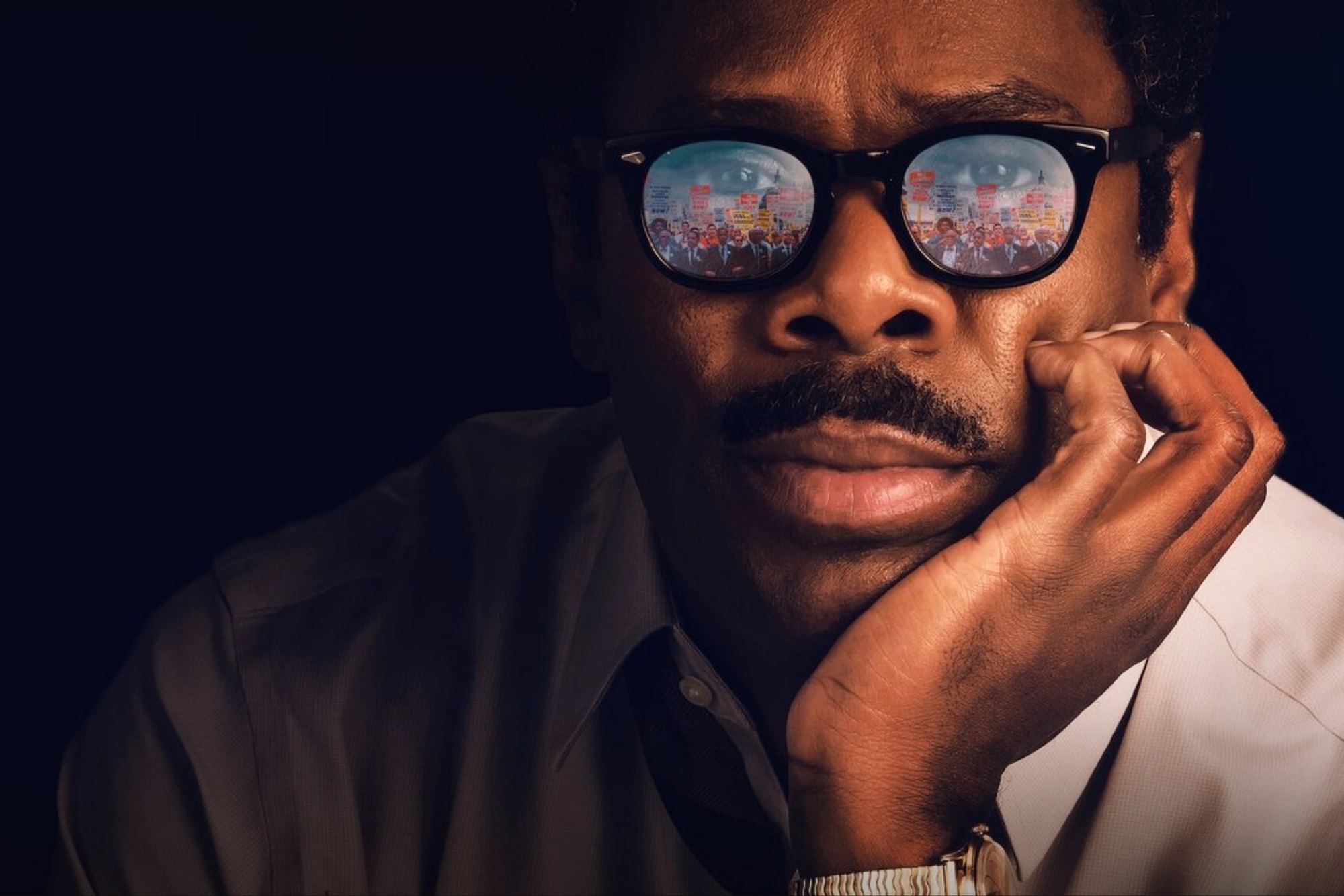
There is a scene, filmed in the dead of the pandemic, in which almost nothing happens and everything does. It is Christmas. Two people are sitting in a diner.
The episode is *Euphoria*'s — one of the two bottle installments shot in late 2020, when the rest of television had gone dark and a hit show reduced itself, out of necessity and then out of nerve, to a pair of people in a booth. On one side is Rue, a teenage addict fresh off a relapse. On the other is the older man from her recovery meetings, the one who came when she called. His name is Ali. He orders food. And then, for the better part of an hour, he does the single hardest thing an actor can do on camera, the thing that separates a craftsman from whatever Colman Domingo is: he listens. He lets the silences stretch until they ache. He watches a girl lie to his face and declines to correct her. In a scene built entirely of talk, he becomes the most magnetic presence on television by doing the least — and somewhere in the second act it lands on you that the stillness is not restraint. It is authority. Here is a man with nothing left to prove and all the time in the world, lending both to someone who has neither.
Colman Domingo was fifty-one when that episode aired. He had been this good for about thirty years. Almost no one had been looking.
Hollywood has a word for what happened to him next, and the word is *discovery* — as though a finished thing can be discovered, as though the man in that booth had been assembled in a workshop the week before. Inside four years he would be nominated for an Academy Award twice, back to back, at an age when the business has historically stopped handing Black men leading roles and started handing them somebody's pastor, somebody's father, somebody's ghost. The trades called it a breakout. A breakout at fifty-four. The word is doing an enormous amount of quiet labor, and most of that labor is cover — for the thirty years the industry had no lead role for a middle-aged Black character man who could hold a diner booth like a Broadway stage.
He came up on those stages, in fact. Born in West Philadelphia in 1969, he spent his twenties and thirties and most of his forties in the theater — *Passing Strange*, a Tony nomination in 2011 for *The Scottsboro Boys*, the kind of credit the film industry files under *respectable* and quietly ignores. For years he was, in the business's shorthand, *that guy*: the face you couldn't name that relaxed you the instant it arrived. *Fear the Walking Dead* let a mass audience finally register the voice — unhurried, amused, always seeming to know more than it was saying. Then came Ali, and the booth, and the Emmy that followed in 2022 for the sin of making listening look like the most dangerous thing a person can do.
He was not unformed, waiting to be developed by some visionary. He was finished — a complete actor, fully in command — for the entire stretch the industry had no use for him. The talent did not ripen late. The attention arrived late, and then had the nerve to call its own delay a fairy tale.
Then came the two years that are supposed to prove the machine works. They prove the reverse.
In *Rustin*, in 2023, he played Bayard Rustin, the openly gay architect of the March on Washington — a man his own movement shoved into the margins for being inconvenient, and whom history obligingly kept there. The nomination that followed made Domingo the first Afro-Latino ever nominated for Best Actor, and the first Black gay man nominated for playing a gay man. Sit for a moment with how late those firsts were arriving: 2024, not 1974. He lost. The next year he was back, as Divine G in *Sing Sing*, a film made shoulder to shoulder with the formerly incarcerated men of the Rehabilitation Through the Arts program — and made, at Domingo's insistence, on terms the industry regards as heresy: one flat day rate for everyone, the star paid exactly what the youngest crew member was paid, more than eighty people holding real equity and cashing checks before a single ticket had sold. Back-to-back Best Actor nominations, a genuine rarity in any complexion. He lost again.
Twice to the front of that room. Twice sent home.
It is worth being precise about what that is, because the polite framing — *what an honor just to be nominated* — is a sedative, and Domingo's career deserves to be read awake. Consider the arithmetic he was nominated into. In the roughly one hundred years the Academy has given out its award for Best Actor, six Black men have won it: Sidney Poitier, then a silence you could raise a child inside, then Denzel Washington thirty-eight years later, then Jamie Foxx, Forest Whitaker, Will Smith, and this March, Michael B. Jordan for *Sinners*. That is the whole list. And when the long silence finally broke, it broke for Denzel playing a crooked narcotics cop in *Training Day* — Black menace, the safest thing that room knows how to reward — after it had passed him over as Malcolm X and as a wrongly convicted boxer. The companion prize for Black women has been won exactly once, by Halle Berry, in 2002; she is still, a quarter-century on, standing up there alone. This is not a category having an off decade. It is a preference, expressed with great consistency, over a very long time.
The business treats a Black actor's age as depreciation — use him young, discard him at forty, cast him thereafter as the wise neighbor who dies in the second act. Domingo did the one thing the model does not price in. He compounded. Every year the room stayed turned away, he was accruing: the theater discipline, the supporting parts where a whole man had to be built and buried inside four scenes, the flat refusal to hand back a smaller version of himself than the one he arrived with.
The business treats a Black actor's age as depreciation. Domingo treated it as compound interest — and walked to the front of the room carrying thirty years the industry never thought it would have to pay.
So retire the discovery story. It flatters the wrong party. The truer story is the one that was visible all along, in a diner, at Christmas, in the pandemic quiet: a man who made stillness look like power because for him it always was, who never once mistook waiting for helplessness. He was not biding time until someone anointed him. He was keeping his own counsel until the room had no choice but to turn around. He holds two nominations and no trophy, and he is still, reliably, the most alive person in any frame he enters — which is not gratitude and was never a mystery. He was this good the whole time. The only thing that ever needed discovering was the industry's willingness to say so out loud.