In 2003, at Baseline Studios in New York, Jay-Z stood in a room with his eyes closed and appeared, for a while, to be doing very little.
There was no notebook in his hand. No loose paper on the console. No pen moving across a page. Rick Rubin had brought in the beat that would become “99 Problems,” and Mike D was there as Jay listened. For roughly twenty minutes, he stood quietly, working through something no one else in the room could see.
Then he stepped into the booth.
Three verses came out in sequence. No visible draft had preceded them. No pages were left behind when the session ended. The lyrics had been assembled privately, held in memory, and delivered only when they were ready to become a recording.
The moment survives because a camera happened to be there.
That footage has always carried a peculiar fascination. Most great bodies of work eventually produce an archive around themselves. There are notebooks, demo tapes, letters, crossed-out lines, alternate versions, studio documents. They offer scholars and fans a way to move backward from the finished work toward the decisions that produced it.
Jay-Z has left remarkably little of that kind of evidence. His writing method, famously internal, removed the paper trail almost entirely. The records remain. So does the man who made them. Much of what happened between those two points has lived, until now, largely inside his memory.
Twenty-three years after the Baseline session, Rubin is sitting across from him again.
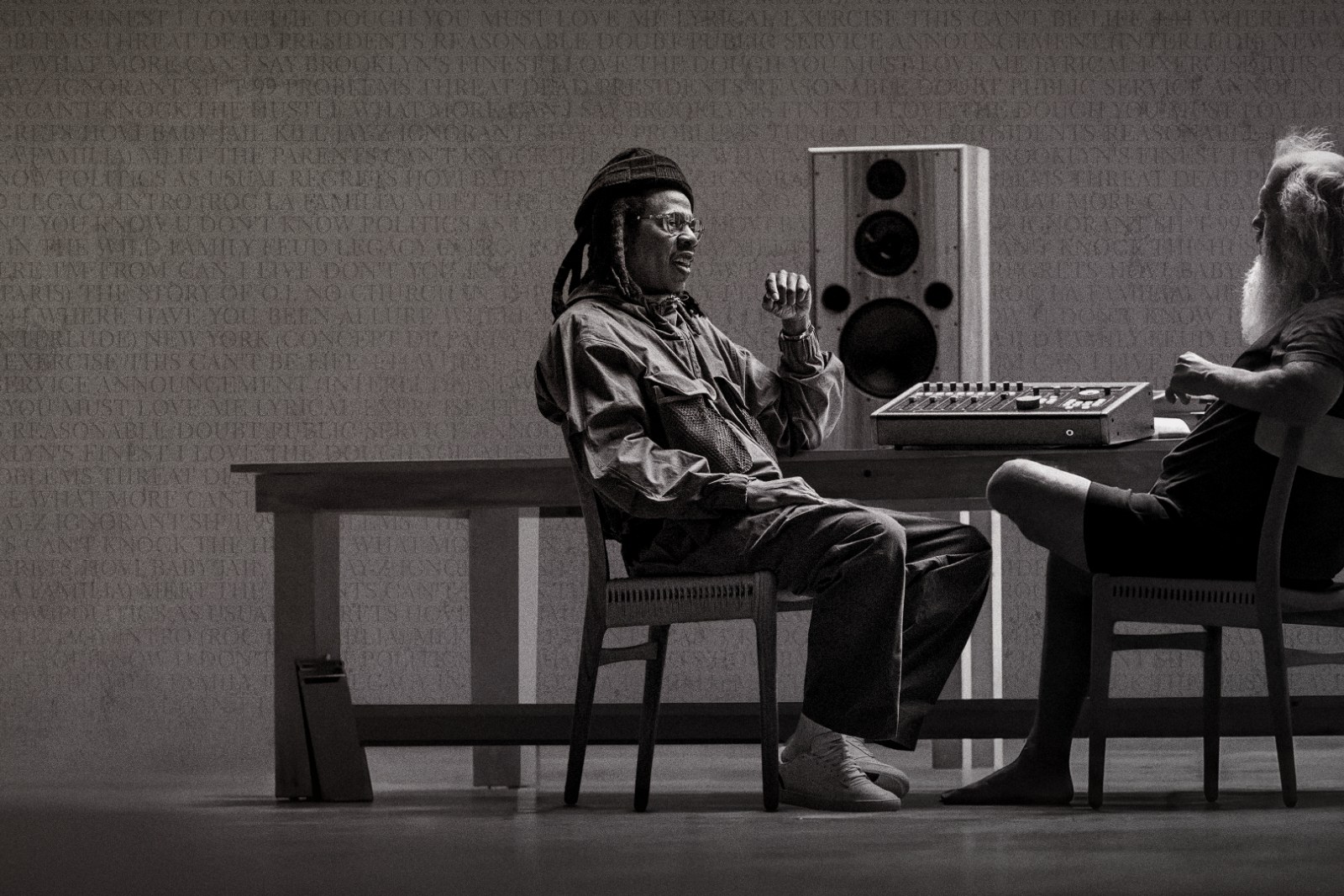
Behind them, a wall is covered from floor to ceiling with song titles.
That image provides the central idea of JAY-Z in 8, an eight-part series unfolding across four weeks. Rubin directs and appears on camera, though his usefulness is not primarily that of an interviewer. He is there because he belongs to the history being discussed. He produced “99 Problems.” He watched part of this mythology form before it had become mythology. When he asks how something happened, he is not asking from outside the room.
The series understands that distinction.
It also understands something else that becomes increasingly important as it goes along. The most revealing way to approach Jay-Z at this point may not be through biography at all.
It may be through the songs.
For years, the broad outline of his life has been told so often that it has acquired the smoothness of institutional history. Marcy Houses. The early records. The independent gamble. Roc-A-Fella. The expansion into business. Ownership. Wealth. Survival. Reinvention.
None of it is untrue. Much of it is extraordinary. But repetition has turned the story into a familiar sequence, and Jay-Z himself has become exceptionally skilled at telling it. Ask for the life story and the machinery of the life story arrives.
Ask why one line follows another, and the conversation changes.
The difference is subtle at first. Rubin asks about particular songs, particular openings, particular decisions. Jay begins talking less like a public figure managing the meaning of a career and more like an artist remembering how something sounded to him before anyone else had heard it.
Early in the series, he says that he did not particularly enjoy many of the obligations that came with being an artist. He disliked shooting videos. He disliked interviews. He disliked speaking publicly. He describes himself, in essence, as an introvert occupying a profession built around exposure.
It is not presented as revelation. That is partly why it lands.
For three decades, Jay-Z has often appeared to embody complete comfort with attention. The records are full of command, appetite, competition and scale. Hearing him separate the pleasure of making music from the machinery required to sell and perform it complicates the familiar image. Some of what looked like ease may simply have been discipline.
Elsewhere, he identifies the opening of The Dynasty: Roc La Familia as a personal favorite. It is the kind of answer that feels small enough to be trustworthy. There is no strategic importance to it. No lesson attached. He is simply talking about a piece of music he made and still likes.
He remembers his mother introducing him to rap through King Tim III. He recalls watching Jaz-O sign a reported $400,000 deal with EMI and beginning to understand the scale of the business around the music. These stories are not entirely new. Their presentation is.
There is a difference between recounting a career and annotating one.
JAY-Z in 8 is most interesting when it stays inside that difference.
The series runs nearly seven hours, a length that will strike some viewers as excessive. But duration is not an incidental feature here. The project covers more than twenty-five songs, drawn from multiple albums and several decades, and it approaches them individually rather than reducing the catalog to a greatest-hits chronology.
That decision places the series closer to extended criticism than conventional music documentary.
Rock music has long been granted this kind of scrutiny. Entire publishing industries have been built around the recording sessions of the Beatles, Bob Dylan and Bruce Springsteen. Individual albums receive books. Studio decisions become historical evidence. Alternate takes are treated as artifacts.
Rap, even at the level of its most canonical work, has not always been afforded the same patience.
The length of JAY-Z in 8 therefore begins to feel less indulgent than deliberate. The series assumes the records can withstand prolonged attention. It assumes the audience might want to know not only what happened in Jay-Z’s life, but why a verse was structured a certain way, why an opening worked, why one record survived and another receded.
Watching two chapters at a time makes the pace easier to understand. This is not seven hours designed to be consumed as one sitting. It is closer to a season of criticism organized around a catalog.
The visual language reinforces the seriousness of that approach.
Bradford Young photographed the series. His credits include Pariah, Selma and Mother of George, and in 2017 he became the first Black cinematographer nominated for the Academy Award for Best Cinematography.
His involvement changes the temperature immediately.
Music documentaries of this sort are often visually functional. Two chairs. Several cameras. A neutral room. The assumption is that the conversation is the event and the image exists simply to preserve it.
Young treats the image as part of the argument.
Jay-Z sits in a wooden chair beneath soft light, often leaning back, thinking before answering. Rubin sits nearby. The wall of songs rises behind them. The frame has weight without calling attention to itself. Black skin is photographed with depth and texture. The room feels intimate but not casual.
The result is less an interview setup than a portrait.
That matters because the series is quietly making a claim about the work before either man begins speaking. This is not merely a successful career being revisited. It is a body of work being considered.
The distinction becomes more meaningful when you return to the way Jay-Z writes.
Because so little was committed to paper, the conventional archive is unusually thin. There are recordings, interviews, business records, photographs and the recollections of collaborators, but there is no vast collection of handwritten lyric sheets through which future scholars can reconstruct the evolution of individual songs.
There may never be.
What JAY-Z in 8 offers, then, is something slightly stranger than a retrospective. It is an attempt to create part of that missing record while the artist is still available to describe it.
The wall behind him lists the songs. Rubin supplies memory from the other side of the console. Jay supplies his own account of instinct, technique and intention. The camera supplies permanence.
No oral history should be mistaken for perfect historical evidence. Memory changes. Artists reconsider their own work. A story told decades later is not the same thing as a notebook written during the session.
Still, there is value in hearing the artist explain the work while he can.
That may ultimately be the series’ greatest importance.
Years from now, when writers and historians try to understand how one of the defining rap catalogs of the last three decades was constructed, they will have the records themselves. They will have the interviews conducted along the way. They will have the testimony of producers, executives, collaborators and rivals.
And now they will also have these conversations.
Seven hours of an artist sitting beside one of the producers who helped shape part of his career, moving song by song through decisions that were once made privately and, in many cases, never written down.
The series is not discovering an archive.
It is beginning to build one.